Knowledge is the antidote to manipulation. Welcome to the stacks.
At The Hairy Times we have our Library — a place where we’ve gathered the important documents, foundational texts, and research we’ve referenced in our articles. We also want to provide what we consider excellent reading suggestions for your reading pleasure. Consider it our receipts — and your homework.
📚 Book Recommendations
Books that cut through the noise — history, politics, economics, culture, and more. Our team only recommends reads that inform, challenge, and occasionally make you want to throw something across the room (in the good way). Each recommendation comes with a note on why it earns a place on the shelf.
Disclosure: Some links below are affiliate links. If you buy through them, The Hairy Times earns a small commission at no extra cost to you. We only recommend books we’ve actually read and believe in.

Regime Change
Maggie Haberman & Jonathan Swan
Maggie Haberman and Jonathan Swan — two of the most deeply sourced reporters covering this administration — take readers inside the return to power and the machinery reshaping Washington in real time. Essential reading for understanding how we got here, and where things go next.

The Laws of Spirit: A Tale of Transformation
Dan Millman
A modern-day parable about inner discipline and the search for meaning, distilling core principles for living with courage, balance, and purpose — a favorite follow-up for readers of Millman’s Way of the Peaceful Warrior.

The Motivation Manifesto
Brendon Burchard & Hay House LLC
Brendon Burchard lays out nine bold declarations for reclaiming motivation, purpose, and personal power — a rallying cry against complacency and an invitation to live with more intention and drive.

How Democracies Die
Steven Levitsky & Daniel Ziblatt
Two Harvard political scientists examine how democracies erode — not through coups, but through the gradual undermining of institutions. Disturbingly prescient. Required reading for anyone paying attention right now.

Dark Money
Jane Mayer
The definitive investigation into how a small network of ultra-wealthy donors — the Koch network in particular — has systematically reshaped American politics. If you want to understand who’s really pulling the strings, read this.

The Fifth Risk
Michael Lewis
Michael Lewis goes inside the federal agencies that quietly keep America running — and examines what happens when political appointees don’t know what they’re managing. A masterclass in why government competence matters.

Noise: A Flaw in Human Judgment
Daniel Kahneman, Olivier Sibony & Cass Sunstein
Why do identical cases get wildly different outcomes? The same judge, different day. The same doctor, different patient. Kahneman and team reveal how “noise” — random variability — corrupts decisions across medicine, law, and government.
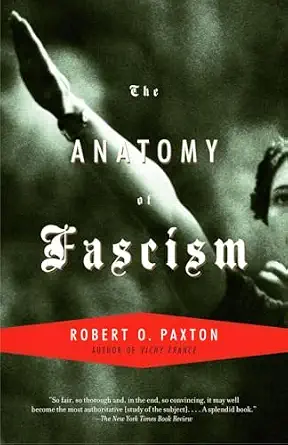
The Anatomy of Fascism
Robert O. Paxton
The essential historical text on what fascism actually is — not as an insult, but as a political movement with specific characteristics. Paxton defines it carefully and traces it through history. Use this as your reference point.

The New Jim Crow
Michelle Alexander
A landmark work arguing that mass incarceration in America functions as a system of racialized social control — the New Jim Crow. Meticulously researched and deeply challenging. Essential reading for understanding criminal justice, race, and systemic inequality.

On Tyranny
Timothy Snyder
Twenty lessons from the twentieth century on resisting authoritarianism. Historian Timothy Snyder distills what history teaches us about how democracies fall — and what individuals can do to prevent it. Short, urgent, and devastatingly relevant.

Blowout
Rachel Maddow
How the oil and gas industry has corrupted democracy around the world — from Oklahoma to Russia to Equatorial Guinea. Maddow follows the money and the power with her signature style. A sobering look at the industry that owns more politicians than any other.

The Shock Doctrine
Naomi Klein
Klein’s essential thesis: that free-market economic policies have been pushed through by exploiting national crises — wars, coups, natural disasters. From Chile to post-Katrina New Orleans to post-invasion Iraq. A challenging, well-documented argument about power and capitalism.

What Happened
Hillary Clinton
Hillary Clinton’s account of the 2016 presidential election — what she saw, what went wrong, and what she believes it meant for American democracy. Agree or disagree with her politics, this is an important firsthand account of a consequential moment in American history.

Fear: Trump in the White House
Bob Woodward
Bob Woodward’s inside account of the first years of the Trump administration. Drawn from hundreds of hours of interviews with firsthand sources. The book that defined how Washington understood the chaos of that White House — and sparked furious denials from within it.
Want to Suggest a Book?
WE’RE ALWAYS READING
Read something that belongs on this shelf? We’re always looking for recommendations from our community. Send us the title and tell us why it matters. If it makes the cut, we’ll add it with a credit to you.
📜 Key Documents & Legislation
The laws, bills, and foundational documents that shape your life — whether they made it to the floor or not. If our reporters cite it, you can find it here.
🔬 Research & Reference
Reports, studies, data sources, and investigative resources that inform our coverage. We believe in showing our work — which means giving you access to the same sources our reporters use. Draw your own conclusions. Form your own opinions. That’s the whole point.
📊 OpenSecrets
CAMPAIGN FINANCE & LOBBYING DATA
The definitive database for tracking money in politics. Who funds whom, how much, and why it matters. Our go-to source for any story involving political donations, PACs, or lobbying.
🏛️ GovTrack
LEGISLATION TRACKER
Track bills through Congress in real time. Voting records, bill status, congressional statistics. If a piece of legislation is mentioned in our reporting, you can track its progress here.
📈 Bureau of Labor Statistics
ECONOMIC & JOBS DATA
Official U.S. government data on employment, inflation, wages, and cost of living. When politicians cite “the economy,” this is the primary source. We use it. So should you.
🔍 ProPublica
INVESTIGATIVE JOURNALISM
Independent, nonprofit investigative journalism in the public interest. ProPublica has broken some of the most important stories in American politics, healthcare, and business. Pulitzer Prize-winning journalism with full methodology published.
✅ FactCheck.org
FACT-CHECKING RESOURCE
A nonpartisan, nonprofit project of the Annenberg Public Policy Center. Monitors the factual accuracy of what politicians say in speeches, ads, debates, and interviews. Use it before sharing anything.
📊 PolitiFact
FACT-CHECKING RESOURCE
Pulitzer Prize-winning fact-checking operation that rates the accuracy of claims made by politicians and political figures on its Truth-O-Meter scale. From “True” to “Pants on Fire.” A useful tool for separating spin from reality.
🕵️ Snopes
FACT-CHECKING & MYTH-BUSTING
The internet’s oldest and most well-known fact-checking site. Specializes in viral claims, urban legends, and misinformation circulating on social media. If you’ve seen something suspicious in your feed, Snopes has probably already checked it.
📈 FRED Economic Data
ECONOMIC DATA • FEDERAL RESERVE
The Federal Reserve Bank of St. Louis’s free database of 800,000+ economic data series. GDP, inflation, unemployment, housing — all the economic indicators politicians cite. Go to the source. Draw your own conclusions.
The Library is updated regularly as our coverage grows. If there’s a document or resource you think belongs here, reach out through our Contact page.